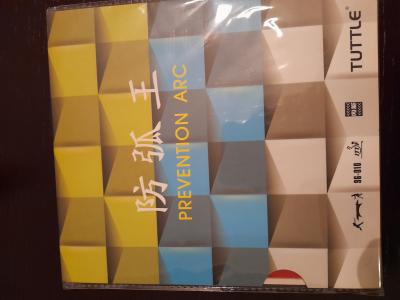
Tuttle Prevention Arc
BUY ONLINE FROM...

User Ratings (11)
Speed 
|
5.4 |
|
Spin
|
5.7 |
|
Control
|
9.2 |
|
Tackiness
|
0.0 Completely non-tacky |
|
Weight
|
1.6 Light |
|
Sponge Hardness
|
0.8 Soft |
|
Gears
|
1.3 Few gears |
|
Throw Angle
|
1.1 Medium low |
|
Consistency
|
10.0 |
|
Durability
|
8.9 Lasts a long time! |
|
Overall
|
|
Tensor |
No |
|
Anti |
No |
Reviews (5)
Tuttle Prevention Arc
Hi! , I'm 57 and still play classic defense. I've found this rubber is perfect for forehand chop, great dampening of loops and arc effects. Just try for 1 month and you'll see. Greetings from Somewhere...
Tuttle Prevention Arc
I was expecting an antispin but it was more like a poor version of Tackiness C. I tested it both for FH and BH. It's quite easy to create spin in the service and also possible to drive and even apply topspin. On the other hand, blocking against topspin was easy. Not so good for chopping.
The real disappointment - didn't last 2 months, rubber unglued easily from the sponge (using only twice a week and didn't apply any booster).
Tuttle Prevention Arc
A strange rubber... Using it on the backhand and needed some time to adjust to it. Generally, it feels more like a normal beginner's rubber than a real antispin. When I try to play as if I hand an antipsin, I don't hit anything. I must imagine to have a normal rubber, just slower and with less spin, then it works.
Uncut weight @1.5mm is 48g (sheet size 165x163mm).
It is not a slick anti, but has some grip left. This "hybrid" style offers interesting options, but also puts the rubber in some place where it's neither a good anti nor a good inverted. While it is easy to return spinny serves and generally offers less susceptibility to incoming spin, you cannot play this rubber completely passive: Strong topspins will still bounce off high if you don't actively block. Strong backspin will put your ball into the net if you don't use the correct push movement. You really must adjust the racket angle accordingly (although of course to a lesser degree than with spinny rubbers), it's not the "one angle fits it all" style like for some long pips.
With this in mind, a very flexible/versatile gameplay is possible. Opening topspins on underspin is possible and often even makes the opponent's return ball fly off the table. Passive strokes result in almost dead balls most of the time, but with use of the wrist, some decent under- oder sidespin can be added. Some balls can be attacked similarly as with short pimples, with a short fast movement above the table, leading to a fast flat trajectory.
In some distance to the table, chopping is easier than with normal rubbers, but needs a bit more practice than with long pimples. But flat-hitting the ball back is also possible for surprise attacks.
Due to its slowness, it's very easy to play short pushes and make short services, although they're not loaded with spin. On blocks, the slower and less spinnny balls are often irritating for the opponent, but there is no strong deception effect like you would expect from a slick anti.
Tuttle Prevention Arc
this rubber is made for control, it's not an antispin just it's very slow and with very little spin. It's perfect for defensive players
BUY ONLINE FROM
Review it!
product
DISCLAIMER: Ratings and reviews are contributed by the table tennis community. We do not certify their correctness. Links to shops are paid links or may provide us an affiliate commission.

About
Founder StoryBlog
Shop
Retailers
Dictionary
Contact
© 2026 Flipspun Inc.
Formerly the Table Tennis Database


