david777783's Blade Ratings/Reviews
Back to david777783's ProfileHere are david777783's ratings and reviews. These ratings are useful because david777783 has his/her own standard and will rate and review the ping pong equipment accordingly, giving you accurate and useful ratings and reviews to aid you in your next online purchase.
Andro (2) 
 |
Andro Kinetic Supreme OFF-
|
||
Review of Andro Kinetic Supreme OFF-While data mining through this site I was pretty skeptic when I found Kinetic Supreme Off- (referred to as KSO- hereinafter) which satisfied all my expectations with a rather low price level, and bought it through second-hand market. But after choosing the right rubbers I'm convinced by the present rating.First I paired it with LSZ999 40 degree 2.2mm and F3 2.0mm, and was disappointed because the F3 side was too quick to loop (the thin and soft sponge resulted in a short dwell time & small margin of error, which also makes pushing almost impossible to control,) and the LSZ999 side was too slow (the Chinese sponge was too hard to hit through, thus wasted the speed of KSO-). So here's a lesson: pair KSO- with a soft enough AND thick enough rubber. Then I glued the LSZ999 and swapped F3 with a glued LSZ999 45 degree 2.2mm, and the performance was improved to an unbelievably monstrous level; it was like the true competence of KSO- was "freed". Its hard, fast but not unbridled feel makes my game exciting. Looping was easy and control was sufficient. (I chose "easy" deliberately since this blade is more like a subsidiary to me, boosting my power, in contrast to other neutral blades.) Pushing was a bit too bouncy but it improved while the sponge gripped the ball correctly. To prevent the idea that I was biased by the glued rubbers, I pasted them on my YE, and difference was huge, as you would expect to see between these two blades. So even with a glued rubber, quality of shots still mainly relies upon blade rather than rubbers. What gluing primarily achieved was simply softening the Chinese hard sponge to improve the grip of the rubber which compensated the shorter dwelling time of the blade (compared with my other slower 5 ply blades like YE or Hurricane King; so I'm not saying that the dwelling time of KSO- is too short, actually I think it is OK considering its speed). So even with an unglued, softer and thicker European/Japanese rubber, I believe KSO- is also excellent for a mediocre looping player like me, who can do basic techniques correctly and quickly, mainly plays at close to mid distance, and needs a faster blade with decent control to provide extra power and improve the game. cons: Although this is a 5 ply blade, its thin outer veneer, thick Kiri core (roughly 4.0mm) and greater overall thickness (roughly 6.7mm) determined that it is unrealistic to expect it to help you create extremely heavy topspins like the ones of Wang Hao, Samsonov, etc. If you're a topspin-addicted advanced player who can generate enormous strength yourself and loves to drive heavy loops at long distance, enjoying acceleration of topspin attacks off opponent's table, you might find this blade too stiff/hard. This is not a pure loop-oriented blade like Hurricane King or Stratus Samsonov Carbon, but rather a versatile blade which can do smashes and close-to-mid-distance quick loops quite well, and the throw angle of its loops are low. And of course, if you are a beginner who are still building up basic mechanics of techniques and are unable to concentrate your strength or consciously and quickly adjust yourself in case of an error, this blade is too fast for you. I didn't rate it because my database was too narrow, but personally I would be willing to rate the overall of KSO- at 9+ since I enjoy it more than other famous blades at the same price level like YE (which is terribly slower) or P700 (which does not provide the same deadly topspin), even slightly more than Offensive Wood NCT (which reflects the skill of player more honestly rather than boosting it like KSO-). Nov 25, 2012 | |||
 |
Andro Temper Tech OFF-
|
||
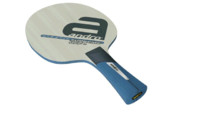
Review of Andro Temper Tech OFF-This is the best blade among my 7 blades for a self-taught beginner, I highly recommend it as a first blade.Its speed is medium-fast, its control is fantastic, it is reasonably stiff/hard, its dwell is good, it's light-weighted and agile, its feel is clear. And it is not expensive. Compared with my other 6 blades this one is clearly the winner considering which one to start with: 1. YE: too slow, too soft, too much dwell, misleading for a beginner who should develop hitting mechanics first for it hinted that loop is more easy way of playing, especially if you pair it with tacky rubbers. 2. P700: fast enough but less dwell. 3. Palio TCT: composite, too hard, zero dwell. 4. Kinetic Supreme Off-: too picky on rubbers, only go well with soft and thick rubbers, and is the fastest among these 7, thus needs quick technique to master. (On the picky thing I assume that a beginner might want to explore in the world of rubbers a little so a picky blade is less interesting... well it's a personal thing. But it is true you might be seriously frustrated if pairing it with a wrong rubber.) 5. Hurricane King: too expensive, and also somewhat misleading since it is purely loop-oriented. A great advanced blade. 6. Offensive Wood NCT: the closest to Temper Tech Off-, both great and versatile, but the feel of hitting of OC-NCT is duller; after all, it is a descendant of the "loop machine" Offensive Classic. As far as I saw, in the field of all-wood blades, only Temper Tech by which this blade was made can best integrate a proper hard feel and thinness and good looping ability into one blade. (Stiga's nano technology was created for similar objectives, that's why OC-NCT and Temper Tech Off- are somewhat functionally similar.) Kiri core is known for its good feel, but since Kiri is naturally hard, to have a good looping performance thinness is required, and without temper tech a Kiri all-wood blade as thin as this one (roughly 5.8mm) could have lost the crispy feel. So you can see andro put respectable effort into designing temper tech blades. My other blades are either too soft to have a good hitting feel or too hard to have a good looping feel. And feeling is of utmost importance for a beginner. (Apart from the subjective sensitive feeling, by "feel" I also meant objective outcome of a stroke. A good feel also means that the relation between your movement and the produced shot is linear so it won't surprise/disappoint you.) Some would say this blade has soft feeling, some say hard, in my opinion this is exactly what temper tech would achieve: a mixed, balanced rather than one-sided feel. How? the softness comes from thinness, and the hardness comes from Kiri and temper tech. For example, this and Kinetic Supreme Off- are both andro off- Kiri blade, but being 1mm thinner, this one is clearly softer in a good way, and only traded for it with a slight reduce of speed, gaining a great leap forward of control. Also, I've never used a blade that performs passive blocks so well, since it is hard but not too hard, thus utilizes appropriate amount of force of a coming shot, which really helps you survive in a point. Passive blocks are actually a very important and often ignored part of playing before you can effectively perform active defensive techniques like counter loop, counter hit or punch during a match. So considering attack and defense together, this blade helps you enjoy playing table tennis. And lastly, Temper Tech Off- is extraordinarily beautiful. Don't be bluffed by the photo here, it is blurred. Google it for a near and clear photo. It's like a classic beauty that gets more beautiful after long-time appreciation. Mahogany is something different. What more could you ask for in this price level? cons: this blade cannot provide long distance heavy loops, but if you've already been that advanced, you will chase a better blade for sure. Before that you should go well with this one for at least half to one year or more. Nov 30, 2012 | |||
Yasaka (1)
 |
Yasaka Gatien Extra
|
||
Review of Yasaka Gatien ExtraI DON'T recommend this as as a first blade. Yes, it is forgiving, its control is superb, its dwell is great, but there are side-effects if you are a beginner.This rampant idea that YE is a perfect first blade might be a remnant of speed-glue era or even small ball era. In current no-VOC glue and big ball era this blade is awfully slow. If you really want to use this to practice, make sure you DON'T pair it with Chinese tacky & hard rubbers, it will absorb your strength, punishes you even you do the right mechanics, if you are not as powerful as a beginner shouldn't be. The softness of YE even make it hard to penetrate harder rubbers-- for me this problem happened on Mark V, which is said to be the classic pair with it. Later when I was a better player and paired Mark V with stiffer blades I then realized how soft it actually is. From that time on I really don't appreciate those who are good enough themselves and assume that every beginner are gonna be able to penetrate Mark V with YE. (I'm not talking about those who already has a solid basis and rediscovered that YE is a great blade; this happens exactly because YE needs you to be powerful enough to enjoy, and probably is an ideal example of how this classic blade should be appreciated nowadays.) I agree with almost all praises other reviews mentioned, but one thing is neglected: if you are not skilled enough, all those advantages don't automatically translate into reasonable amount of points in competition which means sense of achievement. A stiff blade is prone to give you a false sense of achievement & lazy style of playing, but too little of it is also unideal, which makes a rough & ineffective but correct technique indiscernible from a wrong one. This is particularly important if you are self-taught. (So I have no problem recommending YE to recreational use or someone being drilled by a personal coach.) One of the "punishing effects" is this: guess what, YE is worse in passive blocks than stiffer blades. Why? Because to execute passive block, you need a blade that DON'T need any further effort apart from placing the blade at the right place, and when doing so with YE, because the greater flex makes the ball unstable, you easily get the ball into the net or to a undesirable place. Try to be the blocking side in a practice and it will be clear. I think this fact surprises many people, who assume that good control means good defense. Some would say that YE helps you train for better strength, which is true, but I am almost tempted to say that it is a myth that you have to use a blade as weak as YE to build up a good habit of generating enough strength. To do so you just need a blade that is not too fast, having good feel to tell you in real-time that you're doing the right thing. There are loads of blades that can do better than YE about this. But this is a personal thing, whether or not you need YE to prevent yourself from a lazy style of playing is to be judged by yourself only. Since it is true that it is one of the best blades for "recalibration" & self-inspection, I can at least suggest that you can keep it close at hand and switch between it and a primary stronger blade from time to time, if you want. Dec 02, 2012 | |||

About
Founder StoryBlog
Shop
Retailers
Dictionary
Contact
© 2026 Flipspun Inc.
Formerly the Table Tennis Database


